

| |
August 26th, 2009
The April 2009 newsletter for Bethel Mennonite Church, West Liberty, OH, features several members of the congregation who make “going green” a way of life. These creative individuals use rechargeable batteries, compost for the garden, use raked leaves as mulch, carpool, use cotton bags for groceries and heat their homes with wood-burning fireplaces. They even get their pets involved recycling by offering old peanut butter jars as new chew toys. Read more about their resourceful ways of living.
RECYCLING STORIES FROM BETHEL MENNONITE CHURCH
West Liberty, Ohio – April 2009
By Annabelle Hostetler, our 82-year-old church housekeeper
Amazing, isn’t it, that new words come into our vocabulary over a period of years? When I was growing up, we didn’t talk about recycling. We used what we had until it was worn out. We Americans are very wasteful people. If we tire of what we have, we discard it and get new.
Today is a different world. We were taught to turn off lights when not needed (after we got electricity, that is!). How many times do you see lights burning a hole in the day? Let’s conserve electricity!
I was so glad to see recycling come to West Liberty. For years we took it to one location in town. Now all we have to do is put it in our orange containers and put them out at the street.
Did you know you can recycle here at Bethel? There is a container in the Primary Department for your waste paper. My thanks to the person who put it there. Keep your waste paper flat and not crumbled up. Thanks!
I also have a place that reuses the packing peanuts that you get in cardboard boxes. If you have any, just put in plastic bag in the kitchen and I will take care of them. I will recycle the box, too, if you like.
Until this past month, I used my laundry water for more than one load. Saves lots of soap and water! (Ask me, and I will tell you how I did it. J ) But then, I had to get a new washer and with it, modern technology. I am unable to do it anymore. Bummer! I have to watch all the good soap and water go down the drain. L Maybe I can outsmart the washer! J Oh yes, and I will hang my laundry out to dry while I am still able.
As I look out this morning, the grass is starting to get green. Spring is on its way. Let’s each do our part to keep God’s creation as beautiful as He intended it to be!
By Wanda Shumaker, 85-year-old sister of Annabelle Hostetler
In my early years, life was much simpler than today. Country living meant our food was from the farm. We had our meat, milk, and eggs. Vegetables were grown in the garden and truck patch. Weeds were disposed of by hoeing or hand-pulling. Winter supplies were canned or dried. Well water was pumped by hand or the use of the wind wheel. Soft water was pumped from the cistern as long as rain supplies lasted. Laundry water was re-used for several loads. Laundry was dried on outside lines when weather was permissible, otherwise on indoor lines.
We had one outfit for church and changed to our “everyday” clothes as soon as we were home. Our dresses and tea towels were often made from flowered feed bags. (I still prefer “feed bag” towels today.)
Rural electrification came when I was a sophomore in high school. Lights usually consisted of one ceiling light. The rule at our house was “The last one leaving the room turns off the light.”
After the Depression and World War II, the standard of living began changing and improving. Today we have become careless and wasteful. However, I appreciate our many conveniences and luxuries. But many of my old habits of saving are applied today.
Even though it’s time for me to forget gardening, when spring comes I’m anxious to plant a garden. I still can and freeze food.
I am grateful that I can turn on a spigot for water, but try not to use it unnecessarily. Laundry is still dried on the outside line when possible. Although I think I cannot live without electricity I still turn off lights when leaving a room, and turn off the TV and radio when not listening. I am gradually getting all efficient light bulbs. My clothing and household items which I no longer want but are usable I give to charity or put in a garage sale.
Since I no longer have a compost pile, I take excess leaves and yard refuse to my brother, Bill’s compost pile. I have always felt that trees are important to our environment so I have planted at least one tree everywhere I lived. Paper which has been used on one side only, I cut into note-size pieces and use them for shopping lists and “remember notes” to myself.
West Liberty has a great recycling system. Each household is supplied with two orange tubs, one for paper products and one for other recyclable items. When the tubs are full or once a week, I take them to the curb and they are picked up by a recycling company. I have discovered there are several stores in Bellefontaine where you can take plastic grocery and shopping bags. It’s a good way to dispose of them.
We are also fortunate to have Global Crafts Thrift Store. It’s a wonderful place to take good used clothing and household items to be sold. Prices are great for buying too.
God has given us a beautiful and abundant earth. It is up to us to preserve it.
Tags: church, OH, recycle, West Liberty Posted in Congregations | No Comments »
August 26th, 2009
Vegetable gardens are sprouting up in the backyards of churches across the nation. Various reasons lead to this growing trend: the poor economy, climate change, getting kids off the couch, overall well-being etc. For Sarah Scherschligt, associate pastor at Prince of Peace Lutheran Church, the garden is the place where she feels closest to God. No matter the reason for planting gardens, leaders agree that the ministry of planting and harvesting is beneficial for people of all ages within the church and broader community. read more
Tags: community gardens Posted in Congregations | No Comments »
August 26th, 2009
Susan Mark Landis suggests a simple way to green homes and church events in an article written for PeaceSigns, the e-zine for Mennonite Mission Network and Mennonite Church USA. Mark Landis has discovered that shopping at Goodwill and MCC thrift stores is an easy, yet significant, way to care for creation in a consumer-driven society. She buys cloth napkins, mugs and vases for home and church events to reduce waste. These reusable items also feed social interaction as washing dishes together provides ample opportunity for conversation and laughter. read more
Tags: church, clothes, consumerism, Goodwill, home, mugs, napkins, shop Posted in Households/Individuals | No Comments »
August 26th, 2009
Since 1995, Mennonite Central Committee Ontario has donated tons of food to people in North Korea. Even so, the food shortage continues to increase. As a result, MCC has launched a new project expecting to run until 2011. MCC plans to teach “conservation agriculture” to three cooperative farms which are home to several thousand residents who live and work together. Conservation agriculture relies on organic matter and nutrient-rich soil to boost grain production rather than unaffordable materials such as fertilizer and fuel. read more
Tags: agriculture, food, MCC, North Korea Posted in Agencies | No Comments »
August 26th, 2009
By MCCN Staff Writer
Darrin Snyder Belousek knows the value of loving one’s neighbor. This knowledge arises from his experience with a neighborhood movement for justice in Elkhart, Indiana in 2006.
“There was a sense of, ‘Why am I doing this?’” said Snyder Belousek. “It’s very simple – love your neighbors. It’s about banding together and wanting the same thing for our neighbors as for ourselves and working toward that.”
At the same time, Snyder Belousek understands that this kind of “banding together” is not possible without the support of the church. In his one and a half year struggle for justice, Snyder Belousek felt the support of congregations such as Prairie Street Mennonite and Fellowship of Hope Mennonite Church which housed multiple prayer vigils and neighborhood meetings.
Sturgis Iron and Metal, a company based in southern Michigan, established a scrap yard in Elkhart’s industrial area in the 1980’s – a convenient spot located next to the railroad – in hopes that it might become the central site for shredding, processing and shipping out metal. To reach this goal, Sturgis Iron and Metal bought land that would house their “Mega Shredder.” This shredder, the largest in the world, could demolish an automobile as large as a bus.
Unfortunately this piece of property adjoined that of a small, residential neighborhood and this is where the story of justice begins.
“The whole south side of town is not treated with a lot of respect by the city government,” said Snyder Belousek. “It is the historic African American side of town. This [particular] neighborhood is looked on as low-income. The housing prices are near the lowest and there are lots of empty lots with old houses torn down. Many of [the residents] are older and have owned homes there for twenty to forty years and are retiring there.”
Members of Sturgis Iron and Metal and a few officials from Elkhart’s city government visited a similar shredding company in Chicago to view operational standards. As a result of this visit, they concluded that the Mega Shredder would not hinder overall daily life. Snyder Belousek’s research showed otherwise.
According to Snyder Belousek, the Chicago company was located 1000 feet from the nearest residential home with a large buffer zone in-between. This was not the case in Elkhart as the Mega Shredder sat a mere 200 feet from the residential neighborhood. Neither Sturgis Iron and Metal nor the city government accurately calculated the impact of the company’s location and, according to Snyder Belousek, this was the first of three mistakes the city made during the construction of the Mega Shredder in late 2006.
The second mistake was when officials failed to research the overall environmental impact of the Mega Shredder. A quick internet search reveals several negative factors of such a highly industrialized machine. Noise and rust dust come from handling scrap material and an odor of burning rubber and heavy diesel exhaust with a biting metallic taste are a result of residual fluids, oils and gasoline. The smell alone burns the eyes and nose and causes headaches. The first time he felt the vibrations, Snyder Belousek was taking a nap, but the very worst consequences of the Mega Shredder are explosions.
“In the first explosion, we thought the house was hit by a bus,” said Snyder Belousek. “There was a sudden thrust through the whole house. It is like the house bounces on its foundation.”
The third mistake by city officials is that they did not consult with the public. In his research of the Elkhart City Zoning Ordinance, Snyder Belousek discovered greater requirements for heavy industrial equipment such as the Mega Shredder. A series of public processes should have occurred including notification to neighboring property owners and a public hearing before the Board of Zoning Appeals. Also, specific development conditions prohibit toxic emissions and the generation of vibrations.
A neighborhood group organized in April 2006 after several angry encounters with city officials. They called themselves R.E.S.T. – Residents for Environmentalism Stand Together. Snyder Belousek volunteered to research, write and speak but later became the Vice President of the group.
This was the first time since the Civil Rights Movement that people in the south side of Elkhart received proper respect and recognition for organizing and standing for justice.
“It was neighbors defending their homes and their health,” said Snyder Belousek. “It was about integrity and quality of their neighborhood and dignity of themselves and, secondarily, it was about environmental impact.”
Snyder Belousek went on to say, “We had no power or standing in the city. There was no one with us who had any connections. We had no money to work with. We were starting from scratch. All we had was our own voice to speak truth and that’s what we did persistently and repeatedly.”
Members of R.E.S.T. showed up to council meetings, repeatedly speaking up about the situation. After three months, the city government set up a Compliance Agreement with Sturgis Iron and Metal using Elkhart’s Zoning Ordinances as a foundation. Sturgis Iron and Metal was allotted six to twelve months to eliminate dust, vibrations and explosions and moderate noise production. In the meantime, the company could continue their operations without paying fines, unless more explosions occurred. The agreement took three months to create and, again, the public was not consulted.
“The company was allowed to operate outside the limits of the law,” said Snyder Belousek. “Because of the Compliance Agreement, residents couldn’t use noise and vibration ordinances to fight against the company even though every time they turned on the shredder, they were violating the zoning ordinance. That law was there to protect residents but we couldn’t rely on it, our rights were taken away.”
R.E.S.T. acknowledged that Sturgis Iron and Metal did make improvements, but it was not to the satisfaction of the neighboring residents. R.E.S.T. scheduled a meeting with the Mayor and petitioned that the Elkhart division of Sturgis Iron and Metal temporarily shut down until more improvements were made. They also asked the city to conduct environmental impact studies and for legal representation if necessary. Snyder Belousek regrets the latter request.
“I regretted that we threatened to sue the city for violation of our civil rights…because it created an adversarial atmosphere that made it more difficult to work constructively with the city,” said Snyder Belousek. “We wanted to find a resolution within the political process because that would be better for the city as a whole, and threatening a lawsuit did not serve that interest.
“We weren’t going to sue the city for money,” he added. “We just wanted the city to enforce the law. The problem was political – not legal. Who has power? And how do those in power respect or fail to respect those whom they represent?”
The mission of R.E.S.T. was broader than the Mega Shredder, it stretched to Elkhart’s city governance and justice for all people. Over time, the general public realized this mission and supported it.
“Over the course of one and a half years, public opinion shifted to the point where they realized the problem,” said Snyder Belousek. “It was more than just about one industrial operation. It was about how this city is going to be governed and treat their own citizens.”
This story takes a turn in 2007, election year, when Dick Moore came out of retirement to be Mayor.
“The new Mayor said he would take the company on and they did,” said Snyder Belousek. “We could back off and let the city government do the work it was supposed to do.”
Shortly afterward, in the spring of 2008, the company went bankrupt and the assets were auctioned.
Reflecting on the situation stirs up many memories and emotions for Snyder Belousek who said the intention was never to personally offend the Mayor or city council or permanently shut down Sturgis Iron and Metal.
“We were really persisting for a shift in how politics worked in the city,” he said. “We never compromised ourselves. We tried to do our thing with integrity. We were not a Christian organization but everyone involved was a Christian. That’s really what sustained us – that God was faithful and justice would be done.”
In summary, Snyder Belousek shares these wise words:
“The struggle for justice is about moving into a neighborhood and paying attention to what’s going on. [It] is really about loving your neighbors.”
Tags: Elkhart, neighbor, shredder Posted in Agencies | No Comments »
August 24th, 2009
As a follow-up to the creation care Workshops at Mennonite World Conference in Asunción, Paraguay, Mennonite Creation Care Network contacted members of the Creation Care International Planning Committee (IPC) to hear their perspective on just how things went and what hopes they hold for the future.
C. Stuart Clark, Winnipeg, Manitoba, Canada, Senior Policy Advisor of Canadian Foodgrains Bank, chaired the committee’s eight members which represented Paraguay, Indonesia, Bangladesh, Canada and the U.S.
Wilfried Giesbrecht, Loma Plata, Paraguay works for the Foundation for Sustainable Development of the South American Chaco. In this article, he provides insight from the host Country’s perspective.
1. What is your personal interest in the area of creation care?
Stu: My particular concern is doing what I can to reduce my own demands on creation (tracking carbon footprint, reducing heating/cooling energy in my house, reducing consumption, praying to know Jesus’ call to change).
Wilfried: My interest is to disseminate environmental education, biodiversity conservation, water management, sustainable production etc focused on the Biblical view of creation care in order to improve the life conditions of poor people. We are responsible for creation care (God´s mandate in Genesis 2, 15) and the broad view of peace includes peace between people, peace with nature, peace with God etc.
2. What is your involvement with creation care in your home area?
Stu: I am one of the servant leaders of an intentional Christian community where I lead on various environmental themes. I am also the founder of an environmental engineering company in Manitoba.
Wilfried: The Foundation for Sustainable Development of the South American Chaco works on the following activities:
a) Community outreach with rural and indigenous communities in sustainable production and natural resource management.
b) Presentations and environmental education with different groups: youth, students, indigenous, rural population etc.
c) Publishing articles about creation care, environment etc. in the local newspaper.
d) Providing materials (pamphlets, booklets) with methods for environmental education, biodiversity, conservation etc.
3 How did the creation care workshops go? What was the response of those in attendance?
Stu: The workshops were less well attended than I had hoped. Our total audience was just under 300 when we might have had as many as 800. Some of this was location, some was the nature of the Assembly itself and some was the workshop publicity and the failure to indicate that we had four workshops, not one. Those who attended the workshops or came to the booth were enthusiastic and highly engaged.
Wilfried: I think care of creation has gathered a lot of attention and the workshops did go very well. The site for the workshops was located a little bit far from the main place of the MWC, but the response to the workshop was good.
4. What were/will be some challenges for ICP?
Stu: There were remarkably few major challenges given that we were working on four different continents. For the future, it is not clear whether the IPC will have any further role as a group although it is likely that some of its members will undertake some of the outlined proposals.
Wilfried: A challenge was that we started our international planning before we knew each other, but the common interest brought us together…I hope that in spite of the geographical distances, we can continue working together and find a way to become closer in our engagement with creation care.
5. Will the Mennonite Church continue to engage the theme of creation care in the future? What might this look like?
Stu: The General Council has taken the decision to make the Care of Creation a new and urgent theme for the Mennonite World Conference. This will provide a ’space’ for further action but it will be up to interested people to make things happen. At this point, a creation care book for the Global Anabaptist Bookshelf, some form of global international care of creation consultation and a collection of Mennonite songs/hymns dealing with the care of creation are being considered.
Wilfried: The main achievement was for creation care to be included in the agenda of the Faith and Life Commission. As the Care of Creation theme becomes part of the agenda, or even a principle, then it no longer depends on a small group of interested people. In the future creation care will be expressed as part of Christian responsibility and Mennonite Faith.
6. Share a highlight or two from MWC.
Stu: The most remarkable aspect of our experience during MWC was the way that God cleared obstacles out of the way – whether they were technical glitches, missing people or almost aborted important meetings. It was also remarkable that so many people showed up for the first workshop – 120.
Wilfried: MWC was a show or statement of how powerful the Mennonite Community is around the world…A peaceful sharing with many different cultures and without accidents is a testimony of God’s blessings for this event.
***
Other members of IPC include Melani Susanti (Indonesia), Norman Meade (Canada), Susan Wenger (United States), Mokhlesur Rahman (Bangladesh), Luke Gascho (United States) and Wilma Bailey (United States).
Tags: interview, IPC, MWC, Paraguay Posted in Agencies | No Comments »
July 17th, 2009
The conversation began in 2006 when a group of North American young adults, known as BikeMovment, completed a bike ride across the United States. At that time, they wondered about the possibility of riding bike to Mennonite World Conference in Paraguay for the July 2009 assembly. Lars Akerson, Harrisonburg, VA, and Jonathan Spicher, Lancaster, PA did more than wonder, they made that conversation a reality. Their bike journey from Harrisonburg, VA to Asunción, Paraguay for the Global Youth Summit and Mennonite World Conference Assembly began January 6. On July 9, six months, twelve countries and 7,750 miles later, their 27-speed touring bikes came to a stop in Paraguay.
Akerson and Spicher interacted with Eastern Mennonite University’s cross-cultural group in Guatemala and various workers from Mennonite Central Committee, not to mention unexpected and hospitable encounters with many locals along the way. Their vision was to listen, learn and serve while living in community relevant to the teachings of Jesus.
At the same time, Akerson and Spicher raised money for AMIGO’s which, in the last assembly in Zimbabwe, set a goal of raising $100,000 for grants to help young adults attend the Global Youth Summit in Paraguay. Akerson and Spicher hoped to raise $30,000 to reach the goal.
Read more accounts of this adventure and view pictures in their blog.
Tags: bicycling, Mennonite World Conference, Paraguay Posted in Households/Individuals | No Comments »
July 17th, 2009
What’s black and white and red all over? Carmen Schrock-Hurst’s red GEM car affectionately known as “Ladybug.” A Chrysler company in Fargo N.D. is the brains behind this battery-operated vehicle which seats two people comfortably and goes no faster than 25 mph. Schrock-Hurst’s chose not to pay an extra fee to install a heater, air conditioning or radio, but the roll bar, safety glass, turn signals and headlights make it safer than most low-speed vehicles. Ladybug plugs into a regular outlet and uses as much electricity as a computer. On an eight-hour charge, Ladybug will go about 25 miles – a perfect distance for Schrock-Hurst’s commute to work and various errands around town. Read More
Tags: battery, car, Harrisonburg Posted in Households/Individuals | 1 Comment »
July 17th, 2009
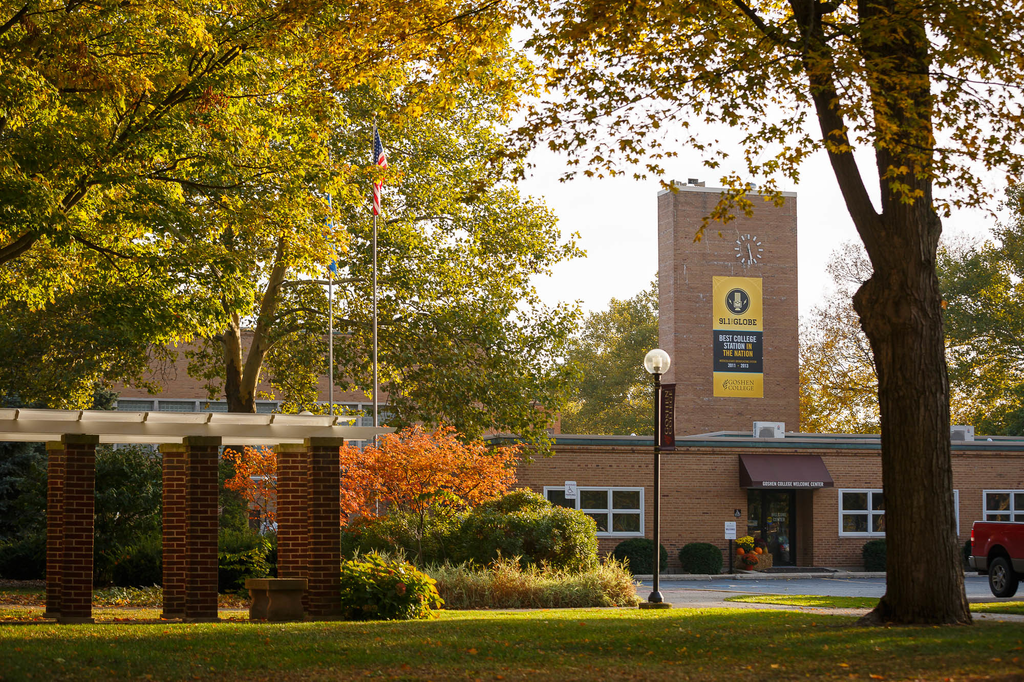
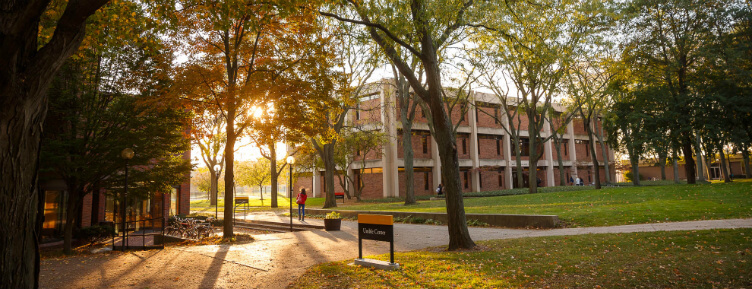
Goshen College hosted the May meeting of the Sustainable Business Roundtable in Michiana, sharing their green practices on campus. And why not when the president, faculty, staff and academic departments are joining together to advance them? The most innovative practice at Goshen College began developing in 1990. The energy management system is monitored on a hand-held computer which notifies the on-call personnel of campus “emergencies” such as an open window over Christmas break or humidity flocculation. Carefully monitored scheduling of lights, heating and air conditioning has caused decreased energy consumption so that Goshen College is using no more energy today than in 1994 despite the increasing dependence on technology.
Managing energy consumption is not the only area where Goshen College is practicing sustainability. Goshen College currently uses biodiesel fuel from the kitchen’s cooking oil waste and has plans to develop solar hot water heating as well as prairie grass plantings to absorb water run-off. Read More
Tags: Energy, Goshen, Sustainability, Sustainable Business Roundtable Posted in Schools, Workplace/Community | No Comments »
July 15th, 2009
When Mennonite Central Committee Ontario discovered a community-based model of buying solar energy in bulk, they created and launched the Mennonite Initiative for Solar Energy (MISE). This opportunity to save money on solar equipment and receive technical assistance began in March 2009 and will continue through November 2009.
The program grew out of a rising interest from individuals who wanted to make their households energy efficient but found the idea of installing solar thermal and solar photovoltaic panels overwhelming on their own. Buying in bulk is cost efficient and, at the same time, eases the confusing process of installation for homeowners. Through this initiative, MCCO is developing “Communities that Care” about creation and people worldwide. MISE also aligns with MCCO’s values of “peace, justice and dignity for all people.”
Over 120 people from various Mennonite and Brethren congregations gathered for the first information meeting at Erb Street Mennonite Church on May 27, 2009. MCCO hopes to launch MISE again in 2010 and invites churches to participate in converting their buildings to solar energy. Read More
Tags: alternative energy, MCC, solar Posted in Agencies | 1 Comment »
|
|
Mennonite Creation Care Network Blog Search
Archives
Categories
|